The Hudson Mohawk Magazine & Sanctuary Radio Interview for the Saratoga History Museum
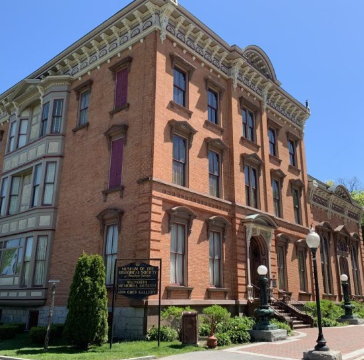
We would like to extend our sincere thanks to Hudson Mohawk Magazine and Sanctuary Radio for recently visiting the Canfield Casino and taking the time to interview our Director, James Parillo, about the Saratoga History Museum, its mission, and the many stories housed within this historic building.
The interview offered a thoughtful look at what it takes to operate one of New York State’s oldest historical societies, while also highlighting the people, partnerships, and community support that make our work possible.
A Conversation About Leadership and Community
During the interview, James Parillo reflected on his path to museum leadership and the learning experiences that shaped his role as director. Like many in the nonprofit world, his journey was not without challenges, but those early lessons helped build the confidence and perspective needed to guide the Museum today.
As discussed in the interview, the Saratoga History Museum operates with a small staff and relies heavily on the dedication of its volunteers. Their contributions—totaling tens of thousands of hours of service each year—are essential to everything from daily operations to public programs and special events. We are deeply grateful for their continued commitment.
Museums Are Built on Human Connection
One of the themes highlighted throughout the conversation was the importance of personal interaction in a museum setting. Whether through guided tours, conversations with visitors, or special programs, the Museum strives to remain approachable and engaging.
For us, history is not something that lives only in text panels—it’s something meant to be shared, discussed, and experienced together.
Facing Challenges and Moving Forward
The interview also touched on the challenges the Museum faced during the COVID-19 pandemic. By approaching reopening thoughtfully and collaboratively, the Museum was able to navigate a difficult period while strengthening internal teamwork and long-term planning.
As James Parillo noted, while we are a nonprofit organization, we must also operate with the mindset of a sustainable business in order to continue offering high-quality programs and preserving Saratoga’s history for future generations.
History, Ghost Stories, and Education
The Canfield Casino’s reputation as a haunted building naturally came up during the discussion. Our popular ghost tours were mentioned as an example of how entertainment and education can work hand in hand.
While many visitors come for the stories, these programs also introduce participants to the building’s history, its artifacts, and the broader historical context of Saratoga Springs—often without them even realizing how much they are learning along the way.
Sharing the Full Story of Saratoga Springs
Another important topic was how history is documented and whose stories are told. While the Canfield Casino reflects the Gilded Age, the Museum is equally committed to highlighting the lives of immigrants, working-class residents, and communities of color who shaped Saratoga Springs long before and beyond that era.
These stories are not always well documented in traditional historical records, making it all the more important to research, interpret, and share them today.
Looking Ahead: The Founders Exhibit
James Parillo also spoke about the Museum’s upcoming exhibit, The Founders, which will explore the history of the Saratoga Historical Society from its beginnings in 1883 to the present day. The exhibit will examine how the organization evolved from a private historical society into a public, community-focused museum housed at the Canfield Casino.
Importantly, the exhibit is designed to be open-ended—reflecting the idea that the Museum belongs to the community and will continue to grow and change with future generations.
With Gratitude
We are thankful to Hudson Mohawk Magazine and Sanctuary Radio for giving us the opportunity to share our story and for helping amplify the work of the Saratoga History Museum. Interviews like this help spark curiosity, encourage dialogue, and invite new audiences to engage with Saratoga’s rich and complex history.
The Canfield Casino will reopen the first weekend of March following its annual renovations. At that time, we will also release our full schedule of programs, lectures, and events for the year, including the opening of The Founders exhibit.
We invite everyone to join us as we continue to explore, preserve, and share the history of Saratoga Springs—together.
You can check out the full audio below and the full transcript as well.
[00:00:00] – Jamie
I was in my stint as an executive director of another organization. Um, didn’t do all that well. I was just — I was too inexperienced and I didn’t know what to expect. Uh, I know there was times in the past when, you know, things weren’t as smooth as they are now. Um, I had a couple board meetings I went to with the resignation, you know, sitting right here in my pocket just in case.
It took me a few years even being here to really get my feet on the ground and build the confidence to take over and be a strong leader.
[00:00:39] – Narrator (Hudson Mohawk Magazine)
You just heard from Jamie Perillo from the Canfield Casino. Jamie’s a lifelong historical reenactor, but he’s better known as the director of Saratoga’s History Museum.
[00:00:52] – Jamie
Well, the director generally is the person that’s responsible for everything. The staff reports to me, and I’m also responsible for the fundraising and, um, planning of special events.
We’re a very small staff. Primarily it’s the volunteers that really help us around. I mean, this year I think they donated about $80,000 worth of donated service alone. I mean, we couldn’t do it without ’em.
[00:01:23] – Interviewer
What led you to become involved with museums generally? It was an accident — is that right?
[00:01:30] – Jamie
Yeah. I grew up, um, nearby in the village of Schuylerville. I always loved Saratoga Battlefield. I was enthralled with the Revolutionary War.
But I also remember as a young kid playing with my, my plastic dinosaurs, and I would build museums, and I said, I’m gonna run a dinosaur museum one day.
And obviously I didn’t take any courses along those lines, but I got a history degree and it morphed into a professional career.
[00:02:03] – Interviewer
It seems like you still get to interact with a lot of people day to day. Is that right?
[00:02:08] – Jamie
Oh yeah, I interact all the time. I mean, in a small museum, you have to. And that’s what keeps your feet on the ground and keeps you fresh too.
If I just sat behind a computer all day, you’re gonna become a curmudgeon and not — and you know — not want to have fun. But working with visitors, giving a tour, that’s what it’s all about. I enjoy it.
[00:02:33] – Interviewer
Did COVID make it hard to stay at all?
[00:02:36] – Jamie
COVID was a challenging time for us. We took it, um, head-on as soon as we got the green light to reopen.
You know, we looked at the guidelines. What did we have to do? Bam — we did it.
So yeah, it actually, I think, helped us build a strong camaraderie, because those of us that worked hard on it together, um, pushed us through.
But by doing that, we were a step ahead of, um, some organizations that didn’t open right away. ’Cause we — even though we’re a nonprofit — um, we’re still a business. And if you don’t operate with the mindset of a business, you’re not gonna make it.
One of my former board members always said to me, he’s like, you can have the best programming in the world, but if you don’t have the money to pay for it, it doesn’t mean a thing.
[00:03:32] – Interviewer
I’ve heard a lot about Canfield Casino being a haunted place, and I’m aware you’ve spent a lot of time here — and on the remnants of battlefields as well. Mm-hmm. And I’m wondering, has your view of the supernatural changed?
[00:03:47] – Jamie
No, it hasn’t changed at all. Actually, I always believed in ghosts. But working here, I’ve just really developed kind of a respect for it — because it’s here. I personally believe in it.
We’ve embraced it here at the museum in a way that, you know, we provide our ghost tours, but we always add that element of education in there.
So whether somebody realizes it or not, when they go on one of our ghost tours, we’re still talking to them about the artifacts. We’re talking about the history of the building, and we force ’em to learn whether they thought they were just coming to be entertained or not.
[00:04:31] – Interviewer
With regard to the ghosts — mm-hmm — do you feel like it matters if it’s true to you or to the public?
[00:04:38] – Jamie
If I don’t believe, I shouldn’t be telling the stories. And we only have a few of us that we’d actually allow to do the ghost tours — at least the ghostly parts of it — because we actually believe.
And most of the people that attend our ghost tours really do believe. There’s always the person that was forced to go on the tour with their friend or spouse, but yeah — my view hasn’t changed at all.
I mean, we are, um — we’re a haunted, haunted building.
[00:05:14] – Interviewer
I’m curious as well — what is the history you’re trying to relate with the Canfield Casino?
[00:05:19] – Jamie
You know, we’re one of the oldest museums and historical societies in the state of New York.
It’s really neat how we were formed — who these people were that formed us — and how the organization changed quite a bit, going from a historical society, which was essentially an elitist organization, to becoming a brick-and-mortar museum, and then coming into this building — the Canfield Casino — making this our permanent home for the past hundred-and-some-odd years.
We’re kind of lucky here with the casino. It was, you know, operated by John Morrissey — an Irish immigrant, Tammany Hall stooge, headed the Dead Rabbits gang. He was a heavyweight prizefighter. He was a congressman.
It’s one heck of a great story — uh, immigrant who became a politician, doing illegal things while making money in the casino and also being in Congress.
[00:06:26] – Jamie (continued)
We focus strongly on the Gilded Age really, because, um, that’s what the building represents. But there’s a lot more to Saratoga Springs history than that.
Pre-Gilded Age, you’ve got Irish immigrants settling in the Dublin area on the west side. Eventually Italian immigrants come in and live there — still called Dublin. African Americans lived over on Congress Street and in Dublin.
So now you’ve got distinct communities. It’s pre-Gilded Age, but it’s a part of the history that’s not well documented because historians traditionally documented the history of the rich and wealthy.
If you look at some of the books that are written — it’s a mess, really. They’re not chronological. They focus on prominent residents because they paid to be included. It’s like a who’s who of the 19th century.
So even that history, you read it with a grain of salt — whether it’s ghost stories or historical facts.
[00:07:45] – Interviewer
Why do you think we keep sharing these records of the past year after year?
[00:07:50] – Jamie
I think people just love to learn about either their past families, their culture, or they look back and always say the good old days.
I’ll tell you what — living in the 19th century probably wasn’t that easy. But I think people like to attach themselves to it.
[00:08:07] – Interviewer
Do you feel the need to correct people’s romanticized views of the past?
[00:08:12] – Jamie
I don’t think it’s my job to change somebody’s mind if they’re happy thinking about it the way they are. But I will always give them the information. It’s up to them to change their mind if they want to.
[00:08:29] – Narrator
Jamie explained that the casino made it easy to strike a balance between entertainment and education. He noted that museum panels are updated yearly as new historical information emerges.
[00:08:43] – Jamie
Now, I hate to say it, but very few visitors will read all the plaques we have up. I mean, I know if somebody is — because it takes ’em four hours to get through this museum.
But usually folks read the first two or three lines. And typically now, if you see a panel with more than 150 words, I’d really love it if somebody would read it — but generally they won’t.
[00:09:09] – Interviewer
Did you ever think about leaving the museum?
[00:09:12] – Jamie
It would take a lot — a lot. And I’m not talking finances.
I enjoy coming to work. I love the people I work with. The volunteers are fantastic. The board members are fantastic. So why give it up?
I do it ’cause it’s fun. And when you’re out in the field talking to visitors and you see their eyes light up — you know you did your job.
[00:09:53] – Narrator
Before interviewing Jamie, I attended the 142nd annual meeting of the Saratoga Historical Society, where he introduced the museum’s newest exhibit, The Founders, opening next year.
[00:10:07] – Jamie
The exhibit doesn’t actually end. We talk about the 2000s — our renovations, our goals — and it’s open-ended.
Because if someday when I retire and I’m gone, and someone wants to add to it, feel free. Because it’s not mine. It’s not Michael’s. It’s not Charlie’s.
This is the community’s museum.
[00:10:41] – Interviewer
Understood. Thank you so much for your time, Jamie.
[00:10:44] – Jamie
You’re welcome. I hope you have a great rest of your day.
[00:10:48] – Narrator
That was Jamie Perillo, acting director of the Saratoga History Museum. The Canfield Casino will reopen the first weekend of March following its annual renovation. The year’s schedule, fundraising information, and monthly lecture series will be released at that time.
This is Joetti Liz and Carmile Meza from Skidmore College, reporting with Hudson Mohawk Magazine.